

Academic Paper
Julian Eschenroeder, Christopher M. Moy, Sebastian Naeher, Marcus J. Vandergoes, Oliver Rach, Dirk Sachse, Rik Tjallingii, Jamie D. Howarth, Adelaine Moody, Xun Li, Claire Shepherd, Elizabeth Kennedy, Lizette Reyes. “Late Holocene climate variability and lake productivity change inferred from the remote alpine catchment of Lake Bright, New Zealand.” Quaternary Science Reviews 374 (2026):109782.
Abstract
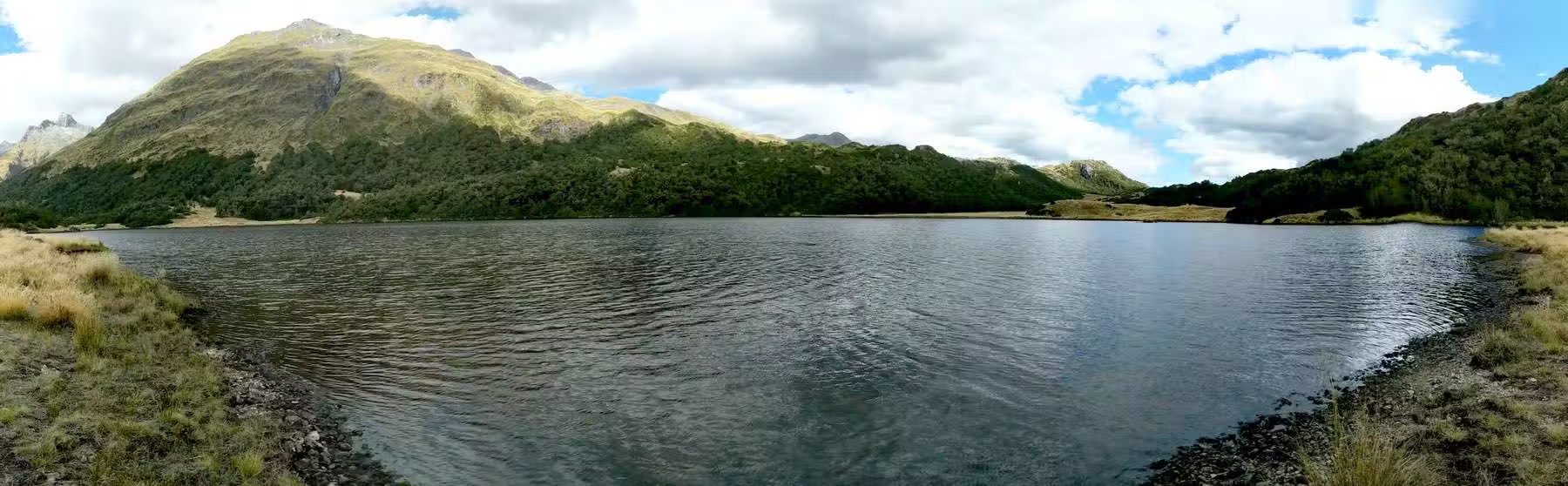
Remote lacustrine environments in the Southern Hemisphere offer rare opportunities to study past climate variability, unaffected by significant human disturbances. Yet, high-resolution palaeoenvironmental reconstructions for the late Holocene remain rare, limiting the current understanding of ecological responses over the last ∼4000 years, to regional climate dynamics. This study investigates late Holocene climate variability and ecosystem responses inferred from sediment cores of oligotrophic Lake Bright located in central Fiordland, Aotearoa New Zealand.
We applied a multi-proxy approach, comprising lipid biomarker analysis (brGDGTs and leaf wax n-alkanes), X-ray fluorescence core scanning (XRF-CS), hyperspectral imaging (HSI), bulk sediment geochemical proxies (biogenic silica, TOC, TN, δ13C, δ15N) and compound-specific stable hydrogen (δD) isotope analysis to sediment cores and modern catchment soils, water, and vegetation samples.
Our results indicate that over the late Holocene, Lake Bright’s productivity was tied to changes in hydroclimate, and in particular to surface runoff dynamics. In this record, phases of enhanced lake productivity correlate with more arid climate intervals, characterised by lower detrital input, independent of temperature fluctuations. In contrast, decreased lake productivity coincides with increased detrital influx, reflecting elevated runoff and enhanced catchment erosion into the lake.
We identify a climatic shift between 2500 and 1500 years ago, possibly marking a transition from a centennial-scale stable climate towards more pronounced hydroclimate seasonality and a stronger influence of the Southern Hemisphere Westerly Winds (SHWW) in the region.
Our findings demonstrate the local influence of regional atmospheric circulation, modulated by the El Niño Southern Oscillation (ENSO) and the Southern Annular Mode (SAM) and offers insights for predicting how alpine lake ecosystems might respond to future climate changes.

